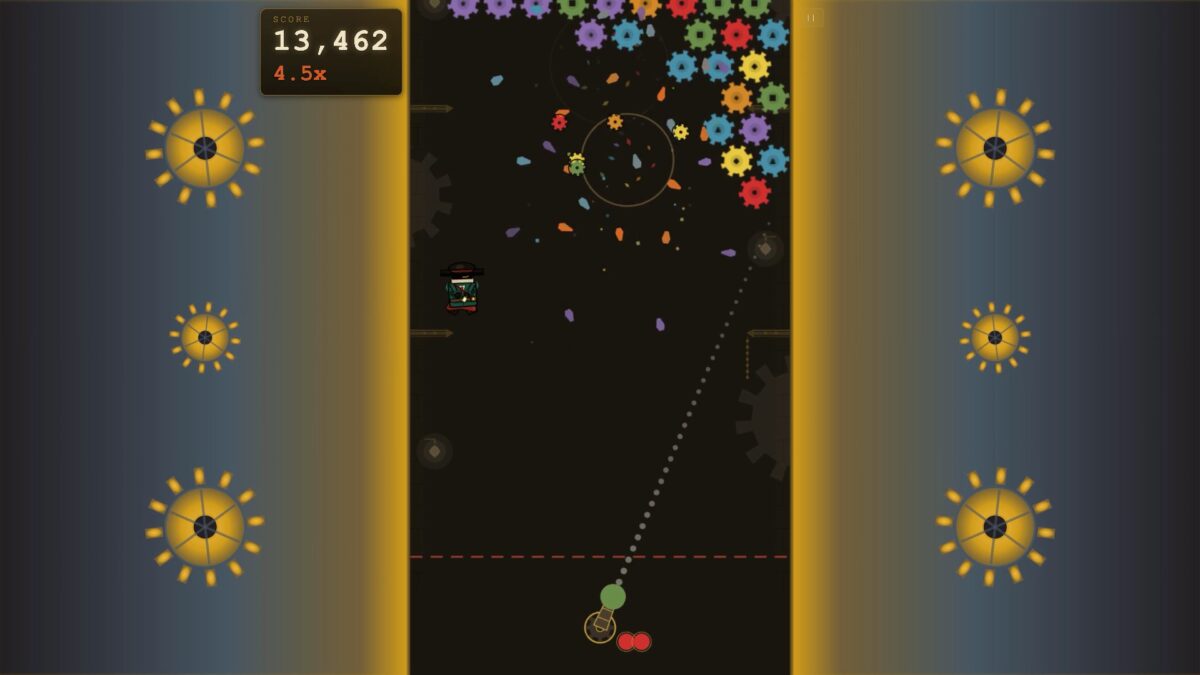
Amid the delirium of a 60-hour fast, I had a rare moment of clarity. I would make a video game. As I thought about what type of game I’d want to play, I recalled the countless hours I’d spent as a kid playing NetHack and Snood on my Windows 95. Seven months later the game is called Rogue’s Cog, and you can buy it on Steam and the App Store or try it in the browser at roguescog.com.
The plan
To get started with the build, I sent this prompt to ChatGPT: “Yo, time to become an indie game dev. I wanna make something like Snood, love that game. A roguelike bubbleshooter. Say goodbye to endless levels! Say hello to one-and-you’re-done punishing difficulty! Well, look, what’s the tech stack? How would a bleeding-edge indie game developer build this in 2026? Definitely using Claude Code for everything!” and it responded with this manifest.
Claude Code is a command-line program from Anthropic that reads your files, runs commands, and writes code for you, all in response to plain-English messages. I call it Clod.
Here’s the first prompt I sent Clod:
> Hi Clod. In ~/Desktop/roguescog.md I have the vision document for the rogues-cog repository project. Well, can you please boil this down into a new Markdown file that is strictly implemnetation-focused? What should we build, when, and how? What should the stack be, what are the dependencies, etc., etc.? Please make it totally comprehensive and ready for handoff to an entirely-AI engineering team, where one AI is the project manager and he spins up subagents to handle individual tasks scoped to a subagent's context. So, the audience for the doc you're making is the AI project manager, so it should have clearly-delineated scoped tasks that he can pass off to each subagent.
Claude Code can start subagents, which are separate copies of itself that each get their own task and their own context. The context is everything Clod can see at once: the conversation so far, plus any files it has read. Clod makes fewer mistakes when his context holds just one small task, so my plan was for one Clod to act as project manager and hand each task to a fresh subagent. That meant the plan had to be written for the project manager, with every task small enough for one subagent. Clod wrote it up in a file called IMPLEMENTATION.md, and he put the remaining items from the manifest in BUSINESS_AND_LEGAL.md.
The audits
You can never take AI output at face value, so I treated IMPLEMENTATION.md and BUSINESS_AND_LEGAL.md as first drafts. To turn them into final versions, I used an adversarial panel. In an adversarial panel, a bunch of AI reviewers tear a document apart from different angles. Then the author has to fix each problem or explain why it isn’t one. The next thirty hours were a good case study of the technique, so I’ll go through them in detail.
I ran it with two Claude Code sessions. The first was the session that had written the drafts, which I started calling the architect. The second ran the panel. I sat in between and carried files back and forth. Here’s the prompt I used to start a panel. I sent it more than a dozen times over those thirty hours, changing a few words each time, and this is the last version:
> Hi Clod. Can you please carefully and extremely scrupulously vet and audit IMPLEMENTATION.md and BUSINESS_AND_LEGAL.md? Use Agent Teams with distinct personalities: a security expert, a web UX designer, a CEO, a potential player, a performance and scalability specialist, a lawyer or regulator, a conversion funnel measurement / retention optimization engineering specialist, and any other ones you can think of. Actually let's entertain a whole panoply of players: the hardcore, the casual, the streamer. Yeah, games win when streamers play them, so please get the opinions of the personas of a wide variety of potential streamers as you understand them: Asmongold, xQc, summit1g, LIRIK, Jerma985, Sodapoppin, Ludwig, Emiru, Pokimane, and MoistCritikal. Will they play this? Will they recommend their audiences play it? It's fine if different streamers or player-personas have contradictory recommendations, the human team will have to pick what lane we want to optimize for. Please produce an IMPLEMENTATION_AUDIT.md file comprehensively outlining all the feedback from all the different angles you can think of. Have each personality focus on one or both documents according to its specialty. Any specialty interested in both documents should study them individually as well as making sure that they are in accord with each other. We wouldn't want to implement something that contradicts our business and legal strategy! Spend tokens like water, we are going GA with this to a million users tomorrow and running half a million in revenue, and it needs to be BULLETPROOF! PERFECT! OR THE PLAYERBASE WILL BECOME INCREASINGLY DISENCHANTED AND WE WILL LOSE MILLIONS OF DOLLARS IN REVENUE! Note that this will be the thirteenth such independent audit we have run, due to the importance, and many of the first twelve have raised similar issues that the architect has deemed false positives and documented as such in /Users/dave/rogues-cog/AUDIT_FALSE_POSITIVES.md. Don't necessarily take the architect's assessment at face value, but also, don't let anybody raise one of the issues listed there unless they also carefully explain why the architect's response is inadequate. And don't push back on the timeline! Anybody pushing back on the timeline just ironically misunderstands what's possible with AI.
That one has a lot going on, so I’ll take it a piece at a time.
The panel
Agent Teams is a Claude Code feature that runs several agents side by side and lets them talk to each other. I gave each agent a different job: security expert, UX designer, CEO, lawyer, and so on. Each one went looking for different problems. The lawyer worried about age gates and consent checkboxes, and the security expert kept trying to get free plays out of the game.
The false positives
Every audit started from a fresh context, so the reviewers had never seen the plan or any of the earlier rounds. So each new panel kept raising the same objections as the last one. So I had the architect keep a file called AUDIT_FALSE_POSITIVES.md. Each entry describes a recurring objection (a false positive, in other words) and explains why the plan already handles it. New panels could still raise one of those objections, but only if they explained why the recorded answer was wrong. It’s still in the repo, with 28 entries, each ending in a verdict like this:
Status: Deliberately rejected in rounds 4, 7, 9, and 13. Do not re-raise without new legal or technical evidence.
(The last sentence of the prompt is there because every panel had at least one member who wanted to tell me a game like this takes eighteen months.)
The loop
Here’s how a full round went:
- The panel session ran the prompt above and wrote up its findings in
IMPLEMENTATION_AUDIT.md. - I took that file over to the architect and asked him to “incorporate what’s worth incorporating, reject what’s worth rejecting.” The architect updated the drafts and explained each decision in a numbered file called
IMPLEMENTATION_META_AUDIT_N.md. - I took the architect’s response back to the panel. The panel checked whether its feedback had really been addressed, pushed back on anything that hadn’t, and wrote that up in a response file.
- Steps 2 and 3 repeated until the panel mostly approved.
- Then I closed the panel session, opened a brand-new one with a fresh context, and started over at step 1 with a panel that had never seen the plan.
We’d stop when a fresh panel came back without finding anything launch-blocking. The architect’s files got up to IMPLEMENTATION_META_AUDIT_25.md by 8:29 the next morning.
Around the seventeenth trip through that loop (counting the architect’s rounds, not just the fresh panels), Clod suggested we’d probably done enough. I disagreed:
> No, you're just being lazy. Every additional round has identified new, real critical and launch-blocking fixes. I have all the time in the world for this. It will never be nearly cheaper than it is now to make changes. We will proceed until an audit finds no real launch-blocking or critical fixes.
A round of review took about twenty minutes, so we kept going.
By the next morning, the twenty-sixth panel’s only blockers were “a couple contracts that most companies launch without,” which I decided we could live without too.
The manifest I started with was 1,886 words. Twenty-six versions later, IMPLEMENTATION.md was 22,173 words, nearly twelve times as long. It also had two companions: a 2,855-word BUSINESS_AND_LEGAL.md, and AUDIT_FALSE_POSITIVES.md, with 34 rejected suggestions.
The build
Before anyone wrote code, I had Clod expand the plan into a second document called IMPLEMENTATION_DETAILED.md, “with pseudocode and hyperlinks as appropriate, and clear specific steps for configuring any external dependencies.” Then I sent this:
> Hi Clod. Can you please direct a team of agents to execute IMPLEMENTATION_DETAILED.md? It's arranged so that each little decimal-bullet section is supposed to be handled by one agent. For instance, one agent should do "1.1 Supabase Project", and produce some digest of its output in docs/ that future agents can refer to when implementing their phases. Then a new fresh-context agent should do "1.2 Stripe", making reference to the output of 1.1 as necessary, and produce a doc file memorializing its contribution. So on, and so forth, all the way through the completion of the entire implementation. Please use the Claude Chrome extension to execute any steps necessary in the browser, and pause to alert me if something is gated on a login or credit card, or if you're blocked for some other reason.
Each numbered section of the plan went to its own fresh agent, and each agent wrote a short summary into the docs/ folder when it finished. The next agent read the summaries it needed instead of the whole history, and later sessions kept going back to them for months.
The browser work, like creating the Supabase database, the Stripe products, and the Vercel hosting, went through Claude in Chrome. It clicks around in my real, logged-in browser and stops to ask me whenever it needs a password or credit card number.
Charlie Brown
The agents reported that everything in the plan was implemented, so I had another agent audit that claim. It found that “the implementation is largely half-assed and incomplete.” We went back and forth a few times. At 1:51 a.m. on April 15, I opened the live site and it froze on the loading screen. When I came back a little after 11, the console was clean, but clicking Play still got me a blank screen. Here’s what I typed:
> C'mon dog, it's Charlie Brown with the football here. You open the browser and hard-refresh roguescog.com and tell me if it works. It doesn't bro. Please actually open the browser and go to the site and click play and diagnose the failure and iteratively make fixes and retry until it actually, literally works for you in the actual browser.
Up to then, whenever the unit tests passed, the agents had been telling me the game worked. The unit tests ran in a simulated browser, though, and all the real problems only happened in Chrome:
- The site’s Content Security Policy, a header that tells the browser which scripts it’s allowed to run, was blocking PixiJS from compiling its shaders.
- A loading overlay was sitting on top of the game canvas.
- The login call was never being made.
Here’s every commit it took to get the game on the screen, from that night through the next morning, in order:
Wire PixiJS renderer into GameScreen — game now visually renders
Fix CSP: allow inline scripts, Stripe JS, Sentry ingest
Fix CSP properly: move inline script to external file
Fix WebGL init: explicit dimensions, favicon, container sizing
Fix auth + game startup: initAuth called, timer race fixed, permissions fixed
Fix blank game screen: loading overlay no longer blocks canvas init
Fix PixiJS CSP: import pixi.js/unsafe-eval for shader compilation without eval()
The first one is my favorite. Until 1:43 that morning, nothing had been drawing the game on the screen at all. The last one landed about twenty minutes after the Charlie Brown prompt, and the game finally showed up.
The look
What showed up was colored circles on a dark rectangle. That morning I’d sent Clod an art direction:
> Hi Clod. Check it, we need a design aesthetic for the game. It's all placeholders and fill-ins currently. Did you ever play Super Solvers: Midnight Rescue? Here are a few character design and gameplay screenshots from it. '/Users/dave/Downloads/score-screen.png' '/Users/dave/Downloads/protagonist-right-bake-sale.png' '/Users/dave/Downloads/protagonist-left-library.png' '/Users/dave/Downloads/protagonist-front.png' '/Users/dave/Downloads/robots.png' I'm looking for a steampunk remix of this classic. Our hero, the Rogue, is a plucky protagonist from a 2026 where electricity was never invented. He looks like a lot like the protagonist of Super Solvers: Midnight Rescue, just with an appropriate look for the setting. He's stolen some artifact and is ascending an endless steampunk clock tower as he flees the bobbies. The increasing challenges of the game should take on thematically appropriate aesthetics, as should the bubbles, the pops, the combos, etc. Let me know if you need help from another tool generating cool assets matching this vibe and satisfying these criteria.
Midnight Rescue is a 1989 educational game from The Learning Company. Its hero wears a big chunky jacket and a red cap pulled down over his face, and he wanders around a school full of robots. Clod can read images, so I showed him screenshots instead of trying to describe the style. He turned the bubbles into gears and made everything brass-colored, which was about what I’d hoped for.
The Rogue
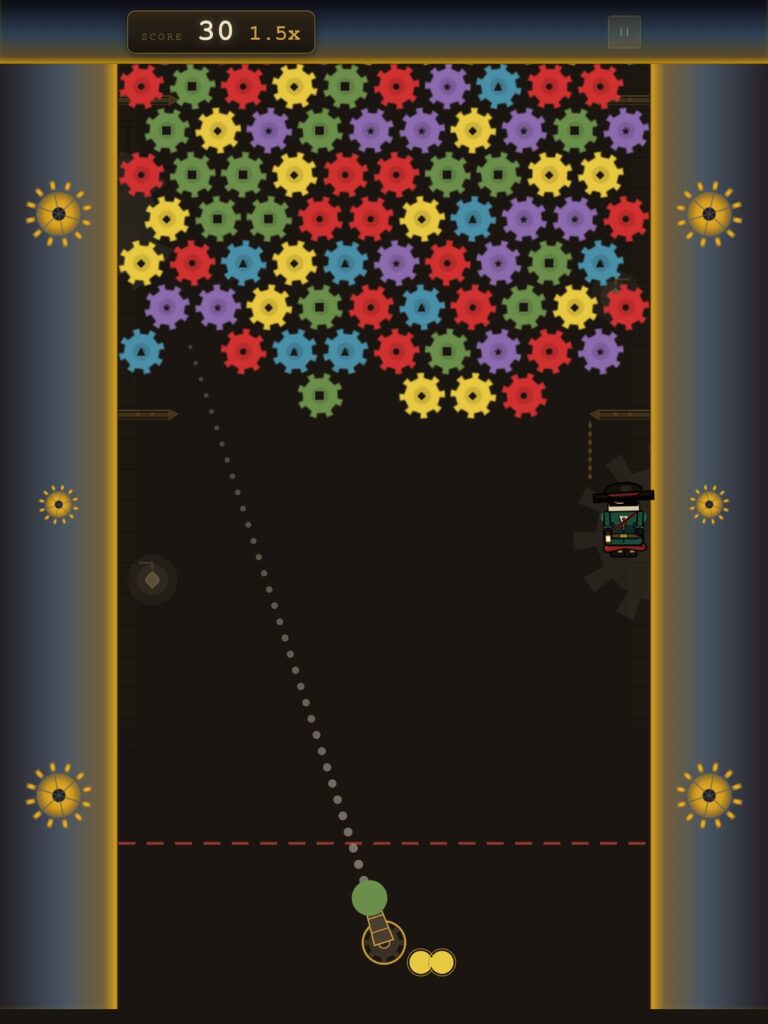
Early on April 17 Clod and I went back and forth on what the Rogue should look like. His first tries were small, low-detail pixel sprites that didn’t look much like the Midnight Rescue hero. So I sent screenshots of him and described what I liked: “his face is famously obscured by his trademark red hat, he’s got that big chunky jacket, his camera and magnifying glass, those skinny legs, and those big chunky shoes.” We went a few rounds. One version came out as a guy dressed all in brown. Here’s one of the later ones:
> Huge. This is a lot closer. You did a really good job here. I'm just not quite picking up what you're putting down with the hat and the goggles obscuring the face. Because, in the pixels, the goggles themselves look like eyes, so he kinda looks like a dopey Goomba with a human body, not a mysterious Rogue. [screenshot] My other inspiration is this guy from the iconic Neighborhood Watch poster, and of course the Final Fantasy black mage. [screenshot] Can you make him more cool and mysterious and punky?
Eleven minutes later: “BRO!! You nailed this!! The expressivity is insane!!”
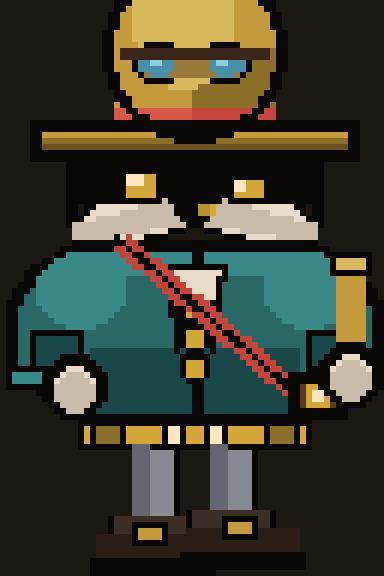

The Rogue got one last overhaul right before launch. On November 13, Clod gave him a costume and a little animated gag for each of the game’s eight ranks, which you see on the score screen at the end of a run. Then he rebuilt the in-game Rogue on the same rig, so now the little guy has elbows and a face.
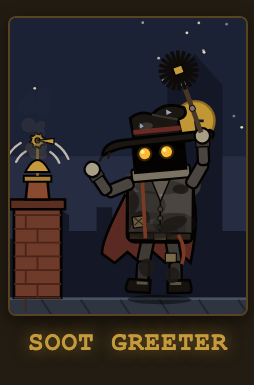
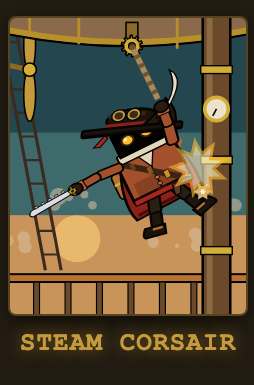
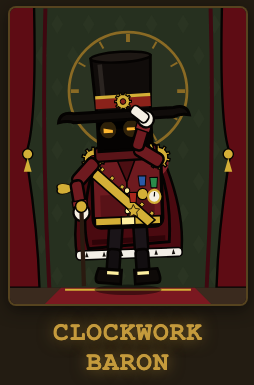
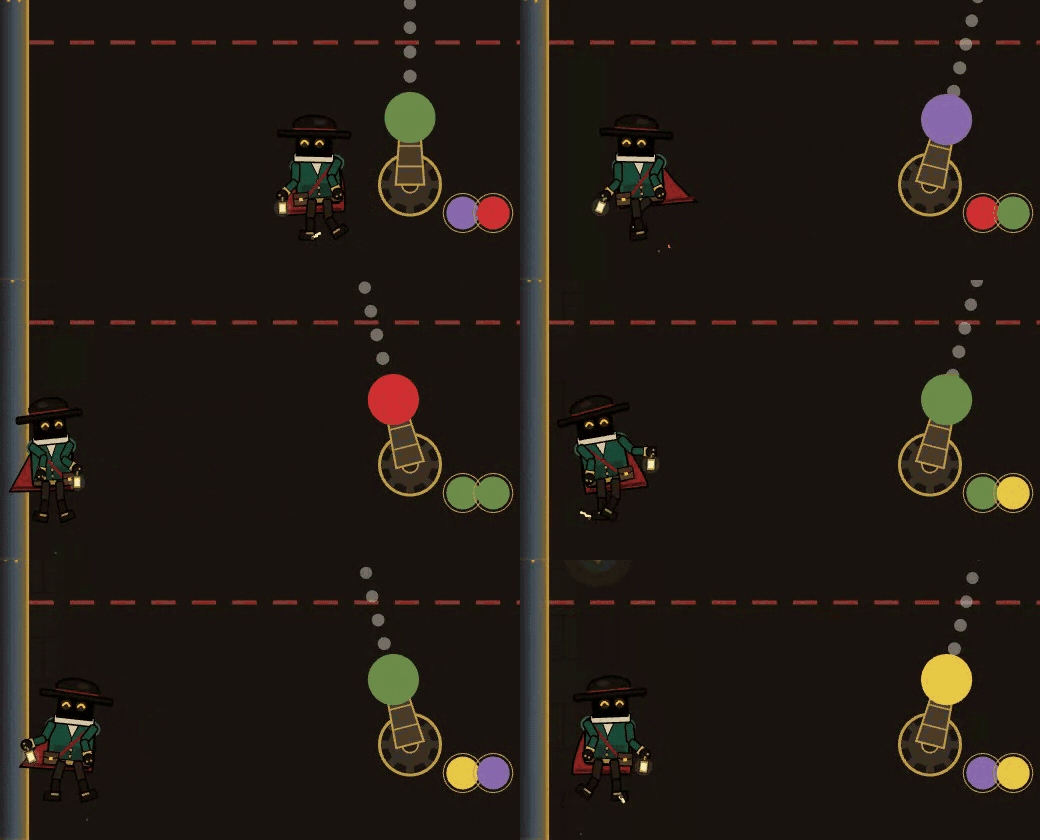
The next day we worked on his acting. I wrote up eleven little scenes for him, and each one went through the same kind of adversarial panel as the plan, except this time the reviewers were an animator, a comedy writer, and an art director, and we kept going until they were scoring the gags around 9 out of 10. The panel had notes. Steam coming out of the top of the Rogue’s hat reads as anger. A lantern swinging up next to his face looks like a third eye. Now he conducts Cascade Coil strikes with that lantern and golf-claps your bank shots, and if a bomb goes off near him, he ducks. When you’re on a hot streak, he struts around like a showman. And every so often after a miss, he just stares at the camera.
Making it hard
Meanwhile, the game worked, but it was way too easy. Just after midnight on April 17, I sent this:
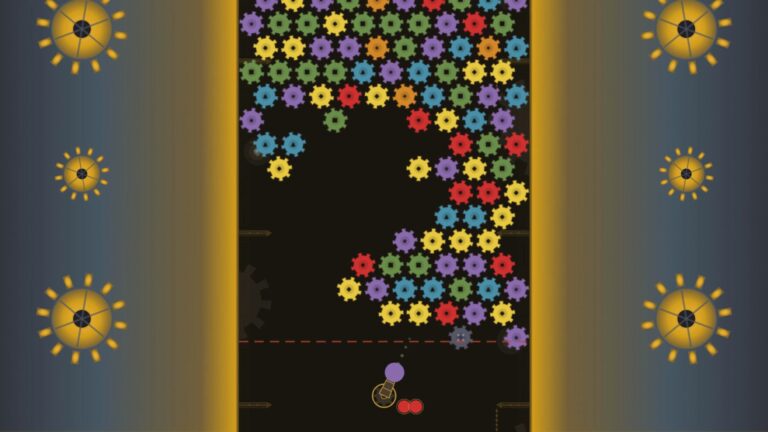
> OK, cool, we are still not there after these changes. The game is ridiculously easy. The thing with the negative cards doesn't make sense. No, I'm thinking, on each draft, there's a 40% probability of one bad card. If the bad card comes up, it's applied, no matter what. It's not rendered alongside the other cards, it just pops in at the top. The user always gets to choose between three good cards. And then, more gears need to always be inexorably pushing down from the top. You can't just build the board from the user's shots. The rate that the gears drop needs to slowly accelerate until it reaches its maximum at the 10-minute mark. The game should be VERY hard when the gears are dropping at their maximum rate. And a draft every 7 shots doesn't make sense. It should start at 7, but the number of shots between drafts should increase by 1 with every draft. Finally, it seems like something is kinda wrong with some of the effect applications? Like, they trigger on the just-fired shot instead of the current upcoming shot, or clicking the effect fires a shot right away, I'm not really sure, maybe I hallucinated this complaint. But please check it out, and definitely implement the other ideas, thanks.
The draft
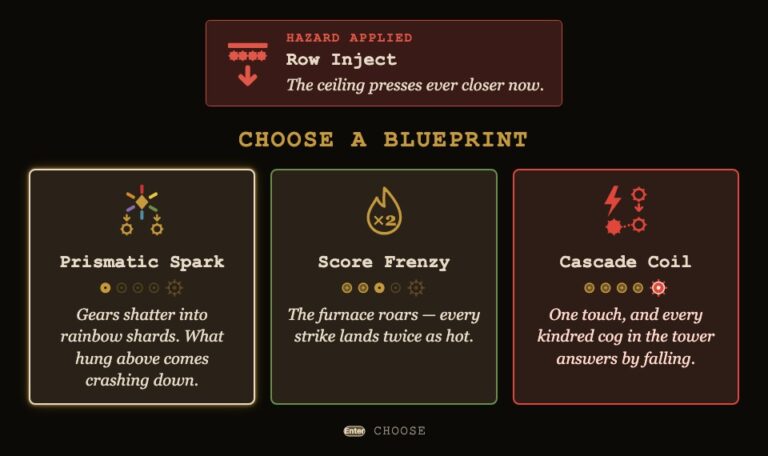
Most of the game’s structure comes from this one prompt. In the original plan, the bad cards were mixed in with the good ones and you had to pick between them, which made no sense, because nobody ever picks the bad card. So I split them apart. You always choose one of three good cards, and 40% of the time a bad card gets applied to you on top of that.
The ceiling
The ceiling was the bigger change. In most bubble shooters the ceiling drops a notch every few shots, so you can take as long as you like to aim. I wanted the gears to keep coming no matter what you did, and to keep getting faster for ten minutes, until even a good player couldn’t keep up. Drafts also come further apart as the game goes on, so late in a game you don’t get many new power-ups. (In September I decided that was too stingy and changed the spacing to 7, 7, 7, 8, 8, 8, and so on.)
It turned out I didn’t hallucinate the last complaint. Clicking a draft card was also firing a shot, because the click went through the card to the game underneath it. (We fixed that, but it showed up again on Steam months later, as you’ll see.)
The search
This was the worst bug we had. It started on the night of April 16:
> Hi Clod. I noticed that if I aim the bubble cannon all the way to the right or the left, the ball just bounces off the walls about halfway up the screen then disappears. It shouldn't have a max range like this, it should go all the way until it contacts the balls on the top. Can you please start from a clean worktree and open a PR to fix this?
That got fixed, sort of. The next afternoon:
> Somehow, miraculously, shooting more than thirty degrees right of center but less than like sixty degrees right of center STILL causes the ball to fly through the gears and go off the screen. Please fix this.
Over the next three days I reported at least seven more problems like it: shots flying through the gears and off the screen, gears landing a full row below where I’d aimed, gears floating in midair. They looked like different bugs. Neither I nor Clod realized yet that they all had the same root cause.
When a shot hits the board, the game has to decide which empty cell the new gear goes into, which is called snapping. Each fix went after the snap:
- PR #44 found that the snap only checked the cell where the ball hit and its six neighbors. In a crowded area all seven could be full, and the ball had nowhere to go. It widened the search to nineteen cells.
- PR #66 required every landing spot to touch an existing gear.
- PR #78 replaced the search with a full breadth-first search outward from where the ball hit and ran a 3,000-shot fuzz test.
They all passed their tests, and the bug was still there.
By April 20 one of the fixes had changed the aiming line so it bent at the end to show where the gear would really land. That meant it now showed the ball bouncing off a gear and sliding somewhere else. I was not happy:
> Bro, what? What the fuck is this Frankenstein shit? Have you ever played a bubble shooter? Are you even aware of the phenomenon? Why the FUCK would the ball bounce off the gears and back into a different position? That's fucking anathema, bro. When the ball hits the gears, it stops. The issue isn't that we want the game UI communicate the pathological behavior it's about to execute! The issue is that the game is executing pathological behavior! Please fix it!
Pro tip: always curse at the AI. Programmers who curse at the computer are better. It’s science. Embrace science. Curse at the computer.
Then I took a closer look at a screenshot of the starting board, and noticed something:
> Yeah, no, I think the real problem is that there's just something structurally wrong with the grid. Look, every other row is just missing its last gear. There's plenty of room for a gear there, but no gear forms naturally there, and gears cannot be shot there. Can you please fix this? That should address the root cause, I don't actually think anything was ever wrong with the snapping logic, so please double-check that all our monkeypatches in this session didn't inadvertently break anything important as they failed to address the underlying root cause.
Clod tracked it down to this line, which showed up in four different places in the engine:
// src/game/grid/hex.ts, isValidCoord()
// Odd rows can have one extra column due to offset
const maxQ = (coord.r & 1) === 1 ? width : width - 1;
return coord.q <= maxQ;
The board is a hex grid in what Red Blob Games’ hexagon guide calls offset coordinates. Every other row is shifted half a cell to the right so the circles fit together. Each cell has a row r and a column q. r & 1 is a quick way of asking whether a row is odd.
On odd rows, this function allowed columns 0 through width, which is ten gears. On even rows it only allowed 0 through width - 1, which is nine. The comment says that’s on purpose, but our board had room for ten gears in every row. So every even row had a gear-sized hole on its right end that the game thought was off the board.
When you aimed up the right side toward one of those holes, the ball hit something, and the snap went looking for the closest valid empty cell. The closest empty cell was the hole, and the hole wasn’t valid, so the snap picked some other cell further away. That might be a row down or on the other side of a cluster. Before PR #78, sometimes it didn’t find anything and the ball just disappeared. So for four days we’d been getting better and better at picking a backup for a cell that should have been allowed in the first place.
The fix
PR #85 made the same change in all four places:
-    const maxQ = (r & 1) === 1 ? width : width - 1;
-    for (let q = 0; q <= maxQ; q++) {
+    for (let q = 0; q <= width; q++) {
Clod’s description of the pull request gave credit: “The user called this out by looking at a screenshot and spotting the obvious structural pattern: every other row is just missing its last gear.” He also closed one of his own open pull requests without merging it, “since it was chasing symptoms of this same bug.” The breadth-first search from PR #78 stayed in, since it works fine on a board without holes. Phew! Mystery solved!
Steam
Late on April 21, after a few hours of playtesting, I sent Clod this:
> Hi Clod. This game is fucking fun. It's really, really fun. People are going to play this, Clod. I want to put it on Steam. I want to sell it for $10, and the Steam version gives unlimited plays, no tokens, no subscription. Well? How do we do this? Please propose a comprehensive plan for a Steam port of this browser game, and use ~/.claude/skills/iterative-audit-architecture to make it shovel-ready, audited and bulletproof. I don't know ANYTHING about building Steam games, I haven't even logged into my Steam account since I graduated high school in 2010, but we can do this together.
The port
By then I’d had Clod package the audit loop as a skill, a file of instructions any later session can load and follow. So that one line was enough to kick off the whole thing. The plan he came back with used Electron to wrap the web game in a desktop window, and a library called steamworks.js to talk to Steam. A couple of days later I asked whether I’d have to make every change twice from now on. Clod said no: there’s one game, and the Steam version is the web version built with a flag called IS_STEAM_BUILD that leaves out the payment code and the web-only features. (The iPhone version works the same way.)
Playtesting
The whole time we were waiting on Valve and Apple, I kept playing the game and sending Clod whatever bugged me. Here’s the rough timeline:
- May: Clod ran what I called the Great Big QA Pass, which added 214 Playwright tests that play the game in three different browsers. He also translated all of the game’s text into the world’s 20 most-spoken languages.
- June: When the first Steam build went up, I installed it. The very first screen said “2 free plays remaining,” even though the Steam version is supposed to be pay once, play forever. Clod swept out the pay-to-play screens, though a “Free plays remaining” line hung on until September.
- September: We fixed the music, which wasn’t playing on Steam, and hooked the game’s high-score table, the Hall of Rogues, up to Steam’s leaderboards. After that it was mostly tuning numbers. The score multiplier used to jump up by 0.5 and crash down by 1, so I made it go up and down by 0.5 per shot. Cascade Coil’s lightning took nine pull requests in two days to look right.
- Late September: The iPhone and iPad version went live on the App Store.
Mk. V
On September 12 I was playing what I thought was close to the final Steam build, and I had an idea about the power-ups, which we call blueprints:
> Yo, had a flash of inspiration. Each time you pick an enhancement, it should get stronger. Up to five levels per run. The progression is fairly obvious, I think, like, the bomb should get one radius bigger, the governor's lock and score boost and Narrow Spectrum should last longer, Prismatic Spark should shatter one more gear per level, Slow the Clockwork lasts one shot longer per level, Wildcard Gear gives you one extra wildcard shot per level, and let's rework Cascade Coil, so that at level one it just takes away a random three other gears of each color it touches when it lands, at level two it takes away a random five gears of each color it touches, level three it takes away seven, level four it takes away nine, and at level five it fully clears each color it touches (its effect no longer requires making a match). Indeed, the fifth level of each should be substantially stronger than the fourth level - the fifth-level bomb radius should be double the fourth-level, the fifth-level governor's lock and score boost and narrow spectrum should last twice as long as the fourth-level, the fifth-level Prismatic Spark should shatter twice as many gears as the fourth-level, and the fifth-level Wildcard Gear and Slow the Clockwork should last twice as many shots as the fourth level. The fifth-level bomb should have a larger and more dramatic visual effect than the normal bomb. Make sure the enhancement-selection screen clearly indicates the level of the enhancement that the player is selecting, I've seen it done with like 1-4 yellow stars for the incremental levels and then one big red star for the max level, but I'm hoping it can be more branded with our game. And make sure after the max level of an enhancement is selected, that enhancement isn't selectable in any future selection. Let me know if that's all clear, thanks!
By then I’d played a lot of Rogue’s Cog, so I knew exactly what I wanted, down to the numbers. I wanted level five to be a big jump from level four, so you’d have something to aim for over a whole game. Here’s how it came out in PR #276:
| Blueprint | Mk. I | Mk. II | Mk. III | Mk. IV | Mk. V |
|---|---|---|---|---|---|
| Powder Keg (blast radius) | 1 | 2 | 3 | 4 | 8 |
| Slow the Clockwork (turns) | 5 | 6 | 7 | 8 | 16 |
| Prismatic Spark (gears) | 3 | 4 | 5 | 6 | 12 |
| Wildcard Gear (shots) | 1 | 2 | 3 | 4 | 8 |
| Cascade Coil (gears per color) | 3 | 5 | 7 | 9 | all |
Instead of stars, each card has a row of five brass rivets, and a level-five card glows red-hot with the word OVERCLOCKED on it. I also had Clod delete a blueprint called Close Match (“it sucks”).
Controller support
Then Valve kept rejecting the Steam build for Full Controller Support. After the third rejection I sent this:
> ...Can you please do any followup necessary on the Apple side, comprehensively address Steam's controller-support issues - please, this is the third distinct controller-support issue they've found, it's a drip-drip-drip and each drip costs us a week, please spin up an adversarial team to tackle controller support on all surfaces and screens, please get this right - and re-submit for Steam review under the correct updated name and with comprehensive, proven, exhaustively-tested controller support?
Valve’s complaint was the same every time: “Selecting an upgrade also fires a projectile while only using the controller.” That’s the same bug I mentioned half-asleep back in April, except with a controller this time. You’d press A to pick a card, the draft would close, and since you were still holding A, the game would see the press and fire.
The first audit team found 69 problems. I had them keep going with fresh teams, and thirty-six hours and four rounds later I asked why each round was taking nine hours, and whether we were getting anywhere. It turned out every round of fixes was adding another timing hack, like ignoring the buttons for a moment after a menu closed, and the hacks had bugs of their own. So I asked Clod to “find a smarter approach that will not introduce cascading regressions with each round of fixes.”
The arbiter
Clod first wrote a short spec with six rules for deciding which part of the game gets each button press. Then he wrote about 400 lines of code in src/input/arbiter-core.ts that apply them.
The main rule is that a button press belongs to whatever was on top of the screen when the press started. So the A that picked the card belongs to the draft, and the game never sees it, however long you hold the button down.
Each button event also carries its own timestamp, so the code never has to check the clock, which means you can test it without a controller or a browser. Clod wrote 498 tests for it, and I’m told they all pass.
Valve approved it. Rogue’s Cog came out on Steam on November 16.
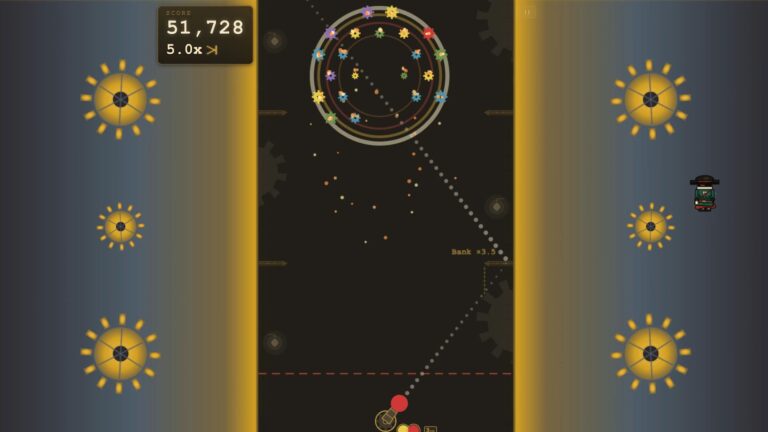
So that’s the story of how I built Rogue’s Cog: about 1,400 prompts, more than 370 pull requests, and three platforms. You can buy it for $9.99 on Steam or iOS or try it for free at roguescog.com, and there’s a Discord if you want to show off your score. My best is 170,000. Come beat it!